

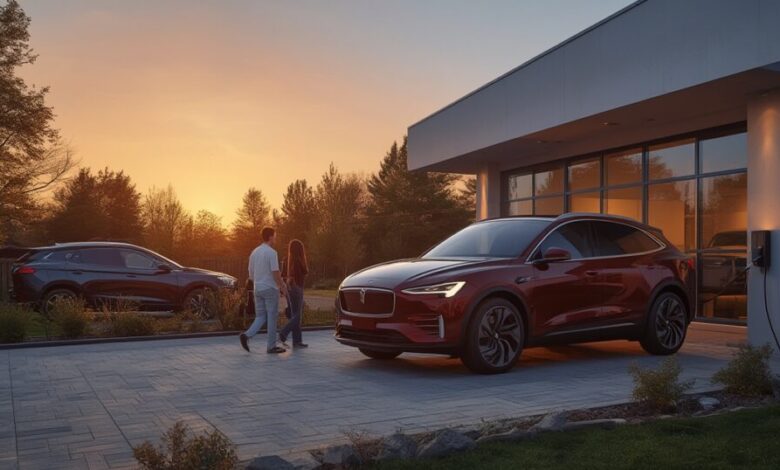
The automotive landscape has transformed dramatically in recent years, with electric cars becoming increasingly practical and affordable for American families. Gone are the days when EVs were niche luxury items or compact commuter vehicles with limited range. Today’s electric cars offer spacious interiors, impressive safety ratings, family-friendly features, and price points that rival traditional gas-powered SUVs and minivans. For budget-conscious families looking to make the switch to electric in 2026, there’s never been a better time to explore vehicles under $50,000 that combine sustainability, low operating costs, and the space needed for car seats, sports equipment, and weekend adventures.
Why Electric Cars Are Perfect for Growing Families
Families considering their next vehicle purchase are discovering that electric vehicles offer unique advantages beyond environmental benefits. The instant torque delivery makes highway merging with a full load of passengers safer and more confident. Regenerative braking systems reduce brake wear, translating to lower maintenance costs over the vehicle’s lifetime.
The quiet cabin experience of EVs creates a more peaceful environment for young children during long drives. Parents appreciate not having to shout over engine noise when talking to kids in the back seat. Additionally, the lack of tailpipe emissions means children aren’t exposed to harmful pollutants during school drop-offs or while waiting in parking lots.
Financial predictability stands out as a major family advantage. Electric vehicles eliminate fluctuating gas prices from the household budget, replacing them with more stable electricity costs. Many utilities offer time-of-use rates that make overnight home charging remarkably inexpensive, sometimes costing the equivalent of less than $1 per gallon of gas.
- Significantly lower fuel costs compared to gas vehicles (typically 60-70% savings)
- Reduced maintenance needs with no oil changes, transmission services, or exhaust system repairs
- Federal tax credits up to $7,500 for qualifying new EVs (income restrictions apply)
- State and local incentives that can add thousands more in savings
- HOV lane access in many states, even with a single occupant
What to Look for in a Family Electric Vehicle
Selecting the right EV for your family requires evaluating different criteria than traditional vehicle shopping. Range anxiety, while less of an issue in 2026 than in earlier years, still deserves consideration based on your family’s driving patterns and access to charging infrastructure.
Seating Capacity and Cargo Space
Most families need at least five seats, but three-row options have become increasingly available in the under-$50,000 electric segment. Battery placement in EVs typically sits low in the vehicle floor, which can compromise cargo space compared to gas equivalents. Look for models that maximize vertical storage or offer frunk (front trunk) storage for additional capacity.
Test the vehicle with your actual car seats if you have young children. Some EVs have seat designs that don’t accommodate bulky rear-facing infant seats well. Check whether the third row (if applicable) can realistically fit teenagers or is only suitable for younger children on short trips.
Real-World Range and Charging Speed
Manufacturer-stated EPA range estimates provide a baseline, but real-world conditions often yield 10-20% less range depending on climate, driving style, and highway versus city usage. For family vehicles, prioritize models offering at least 250 miles of EPA-estimated range to maintain flexibility for spontaneous weekend trips.
DC fast-charging capability matters enormously for families who take road trips. Look for vehicles supporting at least 150 kW charging speeds, which can add 100-200 miles of range in about 20-30 minutes. This transforms charging stops from lengthy interruptions into quick snack and bathroom breaks.
Safety Ratings and Advanced Driver Assistance
Prioritize vehicles with top IIHS (Insurance Institute for Highway Safety) and NHTSA (National Highway Traffic Safety Administration) ratings. Many EVs actually score better in crash tests due to their low center of gravity from floor-mounted batteries, reducing rollover risk.
Standard advanced driver assistance systems (ADAS) have become common in 2026, but implementation quality varies. Features to evaluate include adaptive cruise control smoothness, lane-keeping assistance responsiveness, and automatic emergency braking effectiveness with pedestrian and cyclist detection.
Top Electric Cars for Families Under $50,000 in 2026
The market for affordable family EVs has exploded in 2026, with both established automakers and newer brands competing for family buyers. These vehicles represent the best combination of space, range, features, and value for families with children.
Comparison of Leading Family EVs Under $50,000
| Model | Starting Price | EPA Range | Seating | Cargo Space | Best For |
|---|---|---|---|---|---|
| Chevrolet Equinox EV | $35,000 | 319 miles | 5 passengers | 29.9 cu ft | Budget-conscious families seeking maximum range per dollar |
| Hyundai Ioniq 5 | $43,975 | 303 miles | 5 passengers | 27.2 cu ft | Tech-forward families who value ultra-fast 800V charging |
| Volkswagen ID.4 | $39,995 | 275 miles | 5 passengers | 30.3 cu ft | Families wanting traditional SUV feel with EV benefits |
| Kia EV9 (base trim) | $49,995 | 280 miles | 6-7 passengers | 43.0 cu ft | Larger families needing three rows and maximum space |
| Tesla Model Y (Standard Range) | $44,990 | 260 miles | 5-7 passengers | 34.3 cu ft | Families prioritizing supercharger network access and tech integration |
| Nissan Ariya | $40,980 | 289 miles | 5 passengers | 22.8 cu ft | Families seeking premium interior at midrange pricing |
Detailed Recommendations by Family Type
For families with young children (ages 0-8), the Chevrolet Equinox EV offers exceptional value with its spacious rear seat that easily accommodates two car seats and a booster. The rear door openings are wide, making installation and removal of children much easier for daily routines. Its impressive 319-mile range eliminates most charging anxiety for suburban families.
Families with teenagers or those frequently transporting groups benefit most from the Kia EV9, which barely sneaks under the $50,000 threshold in base configuration. The third row provides legitimate seating for adults, not just small children. The vehicle’s boxy design maximizes interior volume, and the sliding second-row seats offer flexibility for balancing passenger comfort and cargo needs.
Tech-enthusiast families gravitate toward the Hyundai Ioniq 5 for its 800-volt architecture enabling 10-80% charges in about 18 minutes at compatible ultra-fast chargers. The interior features a completely flat floor that makes cleaning up spills and crumbs significantly easier. Vehicle-to-load capability lets you power camping equipment, tailgate setups, or even emergency home backup during power outages.
Understanding Total Cost of Ownership for Family EVs
The sticker price represents only part of the financial equation when selecting a family vehicle. Electric vehicles typically cost more upfront but deliver substantial savings over their ownership period through reduced fuel and maintenance expenses.
Federal and State Incentives
The reformed federal EV tax credit provides up to $7,500 for qualifying new electric vehicles, though income caps and vehicle price limits apply. For 2026, single filers earning over $150,000 or joint filers over $300,000 cannot claim the credit. Additionally, the vehicle’s MSRP cannot exceed $80,000 for SUVs and vans or $55,000 for other vehicles.
Crucially, vehicles must meet North American assembly requirements and battery component sourcing rules. Many of the vehicles in our comparison qualify for the full credit, but always verify current eligibility as regulations evolve. Some manufacturers now offer point-of-sale credits, reducing your purchase price immediately rather than waiting until tax season.
State-level incentives vary dramatically. California offers up to $7,500 in additional rebates through the Clean Vehicle Rebate Project for qualifying buyers. Colorado provides $5,000 for new EV purchases. New York, Massachusetts, New Jersey, and over a dozen other states maintain their own programs that can stack with federal benefits.
Fuel Cost Comparisons
A typical family driving 15,000 miles annually in a 25-mpg gas vehicle at $3.50 per gallon spends approximately $2,100 yearly on fuel. That same family charging an EV at average US electricity rates of $0.14 per kWh would spend roughly $630 annually, saving $1,470 per year or $7,350 over five years.
Families with home solar installations or access to free workplace charging can reduce electricity costs even further. Some employers offer free charging as an employee benefit, essentially providing free fuel for daily commutes.
Maintenance and Depreciation
Electric vehicles eliminate numerous maintenance items over their lifetime. There are no oil changes, transmission fluid services, spark plug replacements, or exhaust system repairs. Brake systems last significantly longer due to regenerative braking handling most stopping force. Consumer Reports estimates EV maintenance costs run about half those of comparable gas vehicles over the first five years.
Depreciation patterns for EVs have stabilized considerably compared to earlier years when battery technology advanced rapidly. Models from established manufacturers with strong warranty coverage tend to hold value better. The federal used EV tax credit (up to $4,000 for qualifying pre-owned EVs) helps support resale values.
Charging Infrastructure and Range Considerations
Successful EV ownership for families hinges on understanding and planning for charging needs. Unlike gas vehicles where fueling happens exclusively at commercial stations, EV charging occurs across multiple locations with different strategies.
Home Charging Setup
Most EV owners complete 80-90% of charging at home overnight. A standard 120-volt outlet (Level 1 charging) adds only 3-5 miles of range per hour, inadequate for most families. Installing a 240-volt Level 2 charger adds 25-40 miles of range per hour, fully replenishing most family EVs overnight.
Level 2 charger installation costs range from $500-2,000 depending on electrical panel proximity and capacity. Many utilities offer rebates covering $250-500 of installation costs. For families in apartments or homes without dedicated parking, this limitation requires evaluation of workplace or public charging alternatives before purchasing.
Public Charging Networks
Network coverage has improved dramatically, but reliability and pricing vary significantly. Tesla’s Supercharger network, now opening to select non-Tesla vehicles, offers the most consistent experience with minimal broken chargers. Electrify America, EVgo, and ChargePoint provide widespread coverage but with more variable reliability.
For family road trips, plan routes using apps like A Better Route Planner or PlugShare. These tools account for real-world charging speeds, elevation changes, and weather conditions to provide realistic travel time estimates including charging stops. Most modern EVs include route planning with charging stops in their native navigation systems.
Cold Weather Range Impact
Families in northern climates should understand that cold temperatures reduce EV range by 20-40% depending on severity. Battery chemistry performs less efficiently in freezing conditions, and cabin heating draws significant power. Pre-conditioning the vehicle while still plugged in warms the battery and cabin using grid power rather than battery reserves.
Despite winter range reduction, EVs excel in snow due to their low center of gravity and instant torque delivery. All-wheel-drive variants available on most family EVs provide excellent traction. The ability to warm the vehicle remotely before exposure to winter weather adds significant convenience for families with young children.
Safety Features and Technology in Family EVs
Modern electric vehicles often debut the latest safety and convenience technologies before they appear in gas-powered equivalents. For families, these features provide both protection and daily quality-of-life improvements.
Crash Protection and Structural Advantages
Electric vehicles typically achieve excellent crash test ratings due to several structural advantages. The absence of a traditional engine creates a larger front crumple zone to absorb impact energy. Floor-mounted battery packs lower the center of gravity, reducing rollover risk in SUV-style EVs by up to 50% compared to gas equivalents.
Battery fire risk, while sensationalized in media coverage, occurs at significantly lower rates than gas vehicle fires according to insurance industry data. Modern EVs incorporate multiple redundant systems to prevent thermal runaway, and first responder training for EV incidents has become standardized nationwide.
Driver Assistance and Automation
Most family EVs in 2026 include standard adaptive cruise control, lane-keeping assistance, blind-spot monitoring, and automatic emergency braking. These systems reduce driver fatigue on long family trips and provide an extra layer of protection against distracted driving moments that occur when managing children in the back seat.
More advanced systems like Tesla’s Autopilot, GM’s Super Cruise, or Hyundai’s Highway Driving Assist 2 can handle extended highway driving with minimal driver input. While these remain Level 2 systems requiring constant driver attention, they significantly reduce the physical and mental strain of highway driving with a vehicle full of kids and cargo.
Connectivity and Family-Friendly Tech
Over-the-air software updates allow EVs to gain new features and improve performance without dealership visits. This capability has enabled everything from increased range through efficiency optimizations to new entertainment features for rear-seat passengers.
Many family EVs now offer integrated streaming services, gaming capabilities for while charging, and advanced climate controls allowing individualized temperature zones. These features transform charging stops from tedious waits into entertainment opportunities that keep children occupied.
Frequently Asked Questions
How long do electric car batteries last, and what happens when they need replacement?
Modern EV batteries typically retain 80-90% capacity after 8-10 years or 150,000-200,000 miles. All manufacturers warranty batteries for at least 8 years/100,000 miles, with many extending to 10 years. Battery degradation occurs gradually rather than suddenly, and most families will sell or trade the vehicle before battery replacement becomes necessary. When eventually needed, replacement costs have dropped below $7,000 for many models and continue declining as battery technology advances and manufacturing scales increase.
Can I take an electric vehicle on a cross-country family road trip?
Absolutely. Modern EVs with 250+ miles of range can handle cross-country trips with advance planning. Charging infrastructure along major interstate corridors has matured significantly. A trip that might take 12 hours in a gas vehicle might require an additional 1-2 hours in an EV depending on route and vehicle. Many families find the enforced breaks every 2-3 hours actually improve the road trip experience with young children, providing natural opportunities for meals, bathroom breaks, and stretching.
What happens if I run out of charge on the road?
Modern EVs provide extensive low-battery warnings starting at 50-100 miles of remaining range, with increasingly urgent alerts as charge depletes. Navigation systems automatically route to nearby chargers when battery drops to critical levels. If you do run completely out, roadside assistance (included with most new EVs) can provide mobile charging or flatbed towing to the nearest charger. In practice, running out of charge happens far less frequently than running out of gas, as most drivers start each day with a full charge from home charging.
Are electric cars more expensive to insure?
Insurance costs for EVs typically run 10-20% higher than comparable gas vehicles, primarily due to higher repair costs from specialized parts and limited repair shop availability. However, many insurers now offer EV-specific discounts recognizing their advanced safety features and lower accident rates. Shopping multiple carriers and leveraging any multi-policy discounts often minimizes the insurance premium difference. Some insurers like Tesla’s own insurance program or State Farm’s EV offerings provide competitive rates specifically designed for electric vehicles.
Do I need a special electrical panel upgrade to install a home charger?
Many modern homes can accommodate a Level 2 EV charger without panel upgrades, requiring only a dedicated 240-volt circuit similar to those used for electric dryers or ovens. Older homes with 100-amp electrical service or panels at full capacity may need upgrades costing $1,000-3,000. A licensed electrician can assess your specific situation. Many utilities offer free or discounted assessments and installation incentives. For families unable to install home charging, evaluate workplace charging options or nearby public Level 2 chargers as alternatives before purchasing an EV.
How do electric cars perform in extreme heat or cold?
Both extreme temperatures affect EV range and performance, though less dramatically than many assume. Cold weather (below 20°F) can reduce range by 20-40%, while extreme heat (above 95°F) typically impacts range by 10-20%. Modern EVs include battery thermal management systems that precondition batteries to optimal temperature ranges. Pre-heating or cooling the cabin while plugged in minimizes range impact. Despite range reduction, EVs remain fully functional in all weather conditions, and their instant torque provides excellent traction in snow and ice when equipped with appropriate tires.
References and Further Reading
- Insurance Institute for Highway Safety (IIHS) – EV Safety Ratings and Crash Test Data
- National Highway Traffic Safety Administration (NHTSA) – Vehicle Safety Ratings
- U.S. Department of Energy – Federal Tax Credits for Electric Vehicles
- Environmental Protection Agency (EPA) – Fuel Economy Ratings and Range Estimates
- Consumer Reports – Electric Vehicle Reliability and Ownership Cost Studies
- Alternative Fuels Data Center – Charging Station Locations and Infrastructure Maps
- Kelley Blue Book – EV Pricing and Depreciation Analysis